Florida Rainy Season: Why Asphalt Fails and How to Prevent Subgrade Collapse
Central Florida is known for its intense afternoon thunderstorms and subtropical humidity. While our vehicles and landscaping endure the rain easily, asphalt pavement faces extreme structural stress during the Florida rainy season.
If your commercial parking lot, HOA community roadway, or residential driveway begins showing spiderweb cracking, depression dips, or potholes after summer downpours, it is not an optical illusion. In Tampa Bay, asphalt failure is directly accelerated by Florida's unique environmental physics.
The Hidden Threat: Florida's Limestone Subgrade & High Water Table
To understand why asphalt fails so quickly in Florida, you have to look beneath the surface.
In many Central Florida developments—particularly those constructed prior to 1990—contractors paved 1 to 2 inches of asphalt directly over crushed shell or native limestone subgrades. In Florida, our shallow water table sits just feet beneath the pavement:
- Water Infiltration Through Micro-Fissures: As asphalt ages under intense Florida UV rays, the binder oxidizes and brittle hairline cracks develop. When tropical downpours hit, standing water penetrates these surface cracks.
- Subbase Liquefaction: Water saturates the underlying crushed limestone or shell base. When heavy vehicles (garbage trucks, delivery vans, passenger cars) drive over wet subbase, hydraulic pressure pumps fine soil particles out from underneath the asphalt.
- Alligator Cracking & Potholes: Stripped of support from below, the asphalt flexes beyond its structural tolerance. This creates interconnected "alligator cracking" that quickly breaks away into deep, hazardous potholes.
The 1960s–1980s Storm Pipe Void Hazard
Older residential subdivisions and commercial plazas built across Tampa, St. Petersburg, and Clearwater often feature corrugated metal storm runoff pipes buried 4 to 6 feet below ground.
Over decades, Florida's acidic soil and standing water corrode the joints of these underground runoff pipes. During peak rainy season floods, storm runoff surges through these corroded joints, washing surrounding soil into the drainage network.
The result is an underground void. On the surface, the asphalt appears intact until a delivery truck or car drives over it, causing a sudden, dangerous pavement collapse or sinkhole.
How to Protect Your Pavement Before Failure Occurs
Waiting until an alligator patch turns into a vehicle-damaging pothole dramatically multiplies your repair budget. Proactive maintenance preserves the subgrade and extends pavement life by decades:
- Crack Sealing Before the Storms: Sealing cracks prevents surface runoff from ever reaching the limestone subbase.
- Commercial Sealcoating: High-grade commercial sealcoating shields the asphalt binder from UV oxidation and creates an impermeable barrier against Florida rainwater.
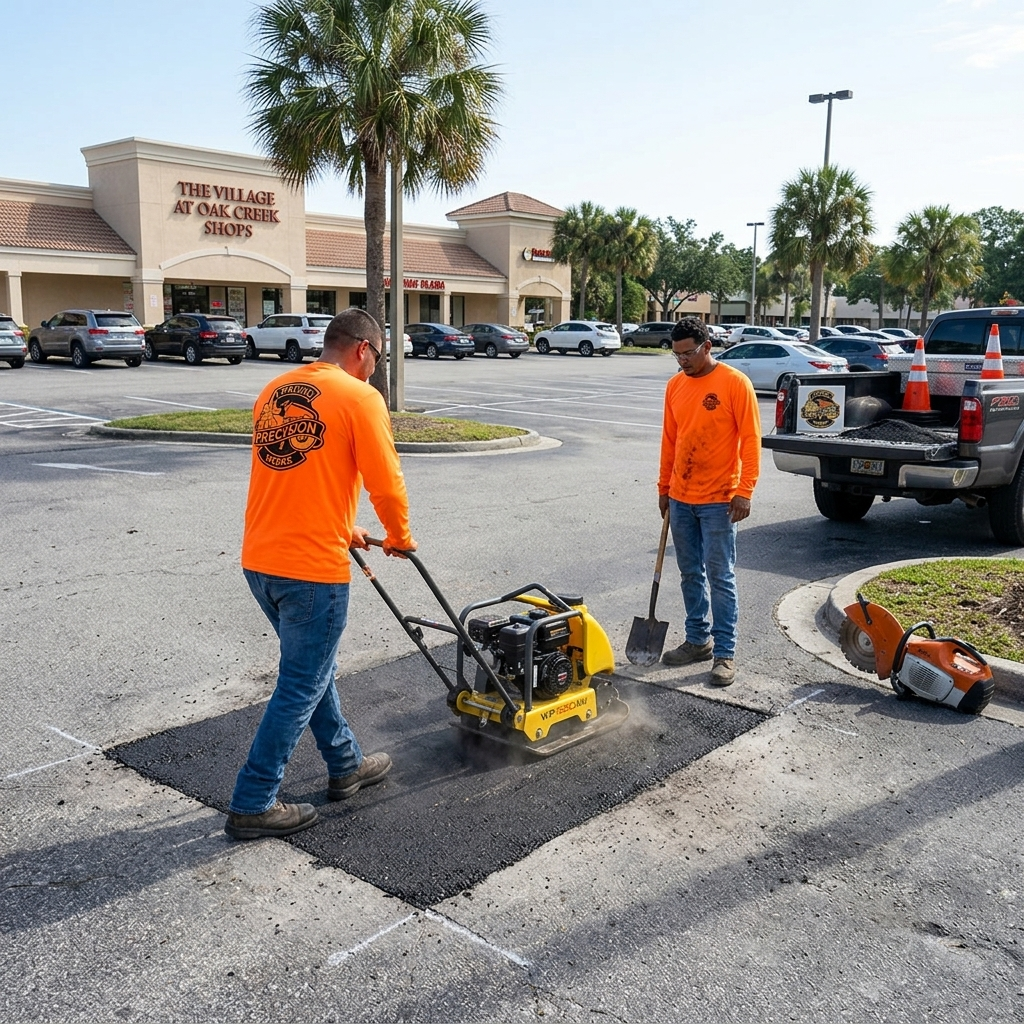
- Full-Depth Asphalt Patching: If the subbase is already compromised, surface skin patching is a waste of money. PPW excavates the failed area down to the subgrade, reinforces the crushed aggregate foundation, and installs hot-mix asphalt compacted to structural grade.
At Precision Paving Works, we believe in honest evaluations and long-term client relationships over short-term sales. We identify the true root cause of pavement failure so you never pay twice for the same repair.
Need an Expert Evaluation for Your Property?
Precision Paving Works provides free on-site consultations, honest root-cause assessments, and zero-obligation estimates across the Tampa Bay area.
Precision Paving Works
Licensed & Insured Florida Paving Specialists
Serving Hillsborough, Pinellas, Pasco, and Sarasota counties with decades of combined commercial asphalt and concrete expertise. We prioritize transparent pricing, relationship-first communication, and permanent engineering solutions.